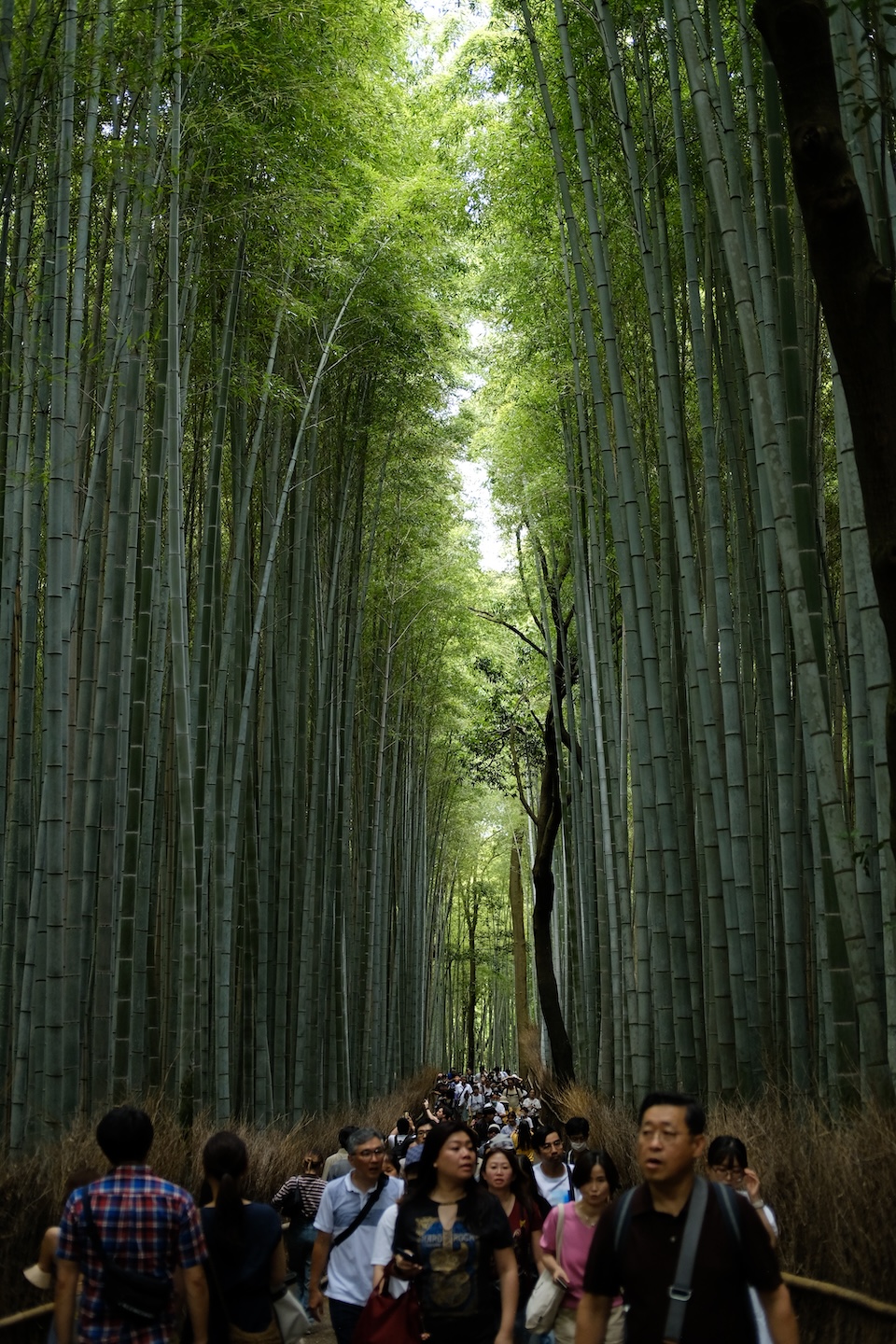
arashiyama
This summer (2023), I traveled to Kyoto with the goal of understanding more about how Modernism and Tradition exist there today. Across hundreds of years, Kyoto City has nurtured rich histories as one of Japan’s premodern capitals. This includes the building of castles, devastating fires, war, festivals, and much more. Today, these histories are manifest in the various well preserved areas of the city including the Gion, Ninenzaka/Sannenzaka, and Pontocho areas. Yet, history is an ongoing process and this face of Kyoto is not the only one that exists today; equally as significant are the early modern and modern histories of Kyoto. The changes that happened during this period can be seen visually when comparing prewar Kyoto’s landscape to the current day landscape. For example, when one arrives in Kyoto, it is most likely in or around Kyoto Station, a building known for its avant-garde steel and glass facade that welcomes the modern age. Furthermore, in recent years, the number of Kyo-machiya (characteristic traditional Japanese style townhouses of Kyoto) has been decreasing drastically, yet various groups are making efforts to preserve them. Japanese people and foreigners alike are investing in machiya, renovating and repurposing them to fit the demands of the present day.
This got me curious about how the state of current day Kyoto might fit in to a history that includes today, perhaps to future historians or people with interest. What is Modern and what is not? What is tradition and what is not? Are they mutually exclusive, existing in two separate worlds?
Throughout my experience, I put together collections of photographs and divided them into two galleries: “Color” and “Renovated Spaces”, each exploring the relationship between Modernism and Tradition in Kyoto through a different lens. When putting together the collections found in the “Color” gallery, I thought about how color is used and regulated in Kyoto, and what this might reveal about the existence of Tradition and Modernism. My “Renovated Spaces” gallery is an exploration of spaces that are associated with tradition in Kyoto, particularly Machiya that have been recently renovated and repurposed.
arashiyama